Australian Shepherd vs Aussiedoodle: Which One Actually Fits Your Home Better?
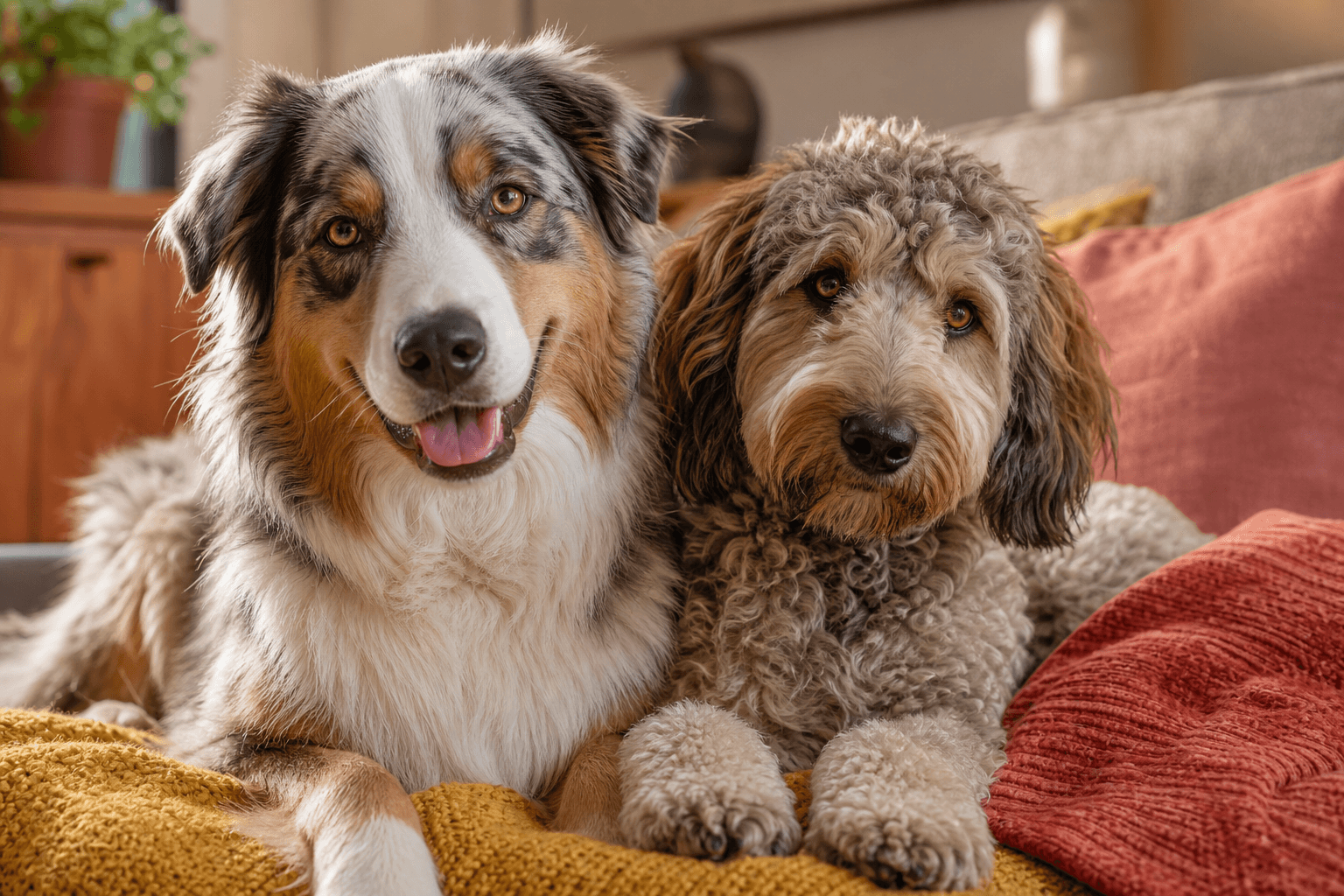
You love the look, the smarts, and the energy. Now you need the breed that genuinely fits your day-to-day life, not your Pinterest board.
We have lived with herders and doodles — here is the straight-to-it guide we wish we had before choosing.
By the end, you will know which one will be content in your space, with your schedule, and your grooming tolerance.
What You Are Really Choosing
Australian Shepherds are purebred herding dogs: intense, loyal, and purpose-driven. Expect a strong work ethic and a dog that wants a job every day.
Aussiedoodles are a cross between an Australian Shepherd and a Poodle. They keep the brains and pep, but the Poodle influence can soften shedding and add a friendlier, go-with-the-flow vibe — with lots of individual variation.
Start with your space and your calendar
Size and Living Space
Australian Shepherds are typically 40 to 65 pounds and medium-bodied. They do best with room to move, but many do fine in apartments if their exercise needs are truly met.
Aussiedoodles range widely. Minis can be 15 to 30 pounds, Standards 40 to 70. If you are in a smaller home, a well-bred mini Aussiedoodle can be easier to accommodate — but the energy level still matters more than the square footage.
Energy and Exercise Needs
Both breeds are high-energy. Plan on 60 to 90 minutes of physical activity daily, plus brain work.
Australian Shepherds skew toward focused, intense activity: hiking, agility, frisbee, herding simulations.
Aussiedoodles are playful and athletic, often thriving on varied activities: jogs, fetch, swimming, and puzzle play. Standards tend to need more than minis.
Temperament and Family Life
Australian Shepherds are velcro dogs with a protective streak. Many are reserved with strangers and may try to herd kids and other pets without guidance.
Aussiedoodles often inherit the Poodle’s social ease. Many are friendly, clownish, and adaptable, though some keep the Aussie’s sensitivity and watchdog instincts.
For households with frequent guests or first-time dog owners, a well-socialized Aussiedoodle can be an easier public ambassador. For owners who love training and structure, an Australian Shepherd’s intensity can feel incredibly rewarding.
Grooming and Coat Care
Australian Shepherds have a double coat that needs brushing a few times a week and more during shedding seasons. Bathing is occasional, trimming minimal beyond paw and sanitary areas.
Aussiedoodle coats vary from wavy to curly. They usually shed less into the environment, but mats form fast. Expect brushing several times a week and professional grooming every 6 to 8 weeks.
If you want low daily hair on furniture, the Aussiedoodle wins. If you want lower grooming bills and simpler upkeep, the Aussie is simpler.
Shedding and Allergies
Australian Shepherds shed consistently, with heavier seasonal blowouts. Lint rollers are your friends.
Aussiedoodles are often lower-shedding, especially curlier coats. But no cross is guaranteed hypoallergenic. Allergy responses vary by person and by dog.
Trainability and Mental Work
Both are highly trainable. Australian Shepherds thrive with clear rules, consistency, and jobs that tap precision and impulse control.
Aussiedoodles learn quickly and often enjoy variety and games. Standards especially excel at advanced obedience, tricks, and water sports.
Whichever you choose, plan for daily training reps, puzzle feeders, sniff walks, and rotation of toys to prevent boredom-barking and creative mischief.
Health and Lifespan
Australian Shepherds: watch for hip dysplasia, epilepsy, eye issues such as cataracts and CEA, and MDR1 drug sensitivity. Ethical breeders avoid risky merle-to-merle pairings.
Aussiedoodles can inherit risks from both sides: hip dysplasia, eye diseases, ear infections with floppy ears, and in Standards, bloat risk. Some also carry MDR1. Lifespan for both is commonly 12 to 15 years, with minis trending longer.
Health testing matters more than labels. Ask for hip and elbow scores, eye clearances, and relevant genetic panels for parents.
Cost and Availability
Purchase price varies by region. Aussiedoodles from health-tested programs are often pricier than Australian Shepherds.
Ongoing costs differ: Aussies spend more on de-shedding tools; Aussiedoodles spend more on grooming appointments. Training classes and activity fees are smart line items for both.
Quick Chooser
Choose an Australian Shepherd if...
You want a purpose-driven partner for structured activities, do not mind seasonal shedding, and enjoy daily training with clear rules.
Choose an Aussiedoodle if...
You want a social, athletic companion with typically lower shedding, and you are willing to budget time and money for regular grooming.
Pros
Aussiedoodle Pros
- Often lower-shedding than Aussies
- Social, adaptable temperament in many lines
- Coat options and sizes from mini to standard
- Takes well to varied sports and family life
Cons
Aussiedoodle Cons
- Professional grooming every 6–8 weeks is typical
- Not guaranteed hypoallergenic; coat and dander vary
- Energy still high — needs daily jobs
- Quality and temperament vary widely by breeder
Before You Decide
- Match energy first, looks second.Both breeds are beautiful. Choose the one whose activity needs you can meet on your worst week.
- Plan the daily schedule.Who does the morning walk, midday break, evening training, and brushing or grooming?
- Meet adults, not just puppies.Ask to meet stable adult Aussies or Aussiedoodles from the same breeder or rescue for a truer picture.