7 Things to Know Before Getting a Crested Gecko
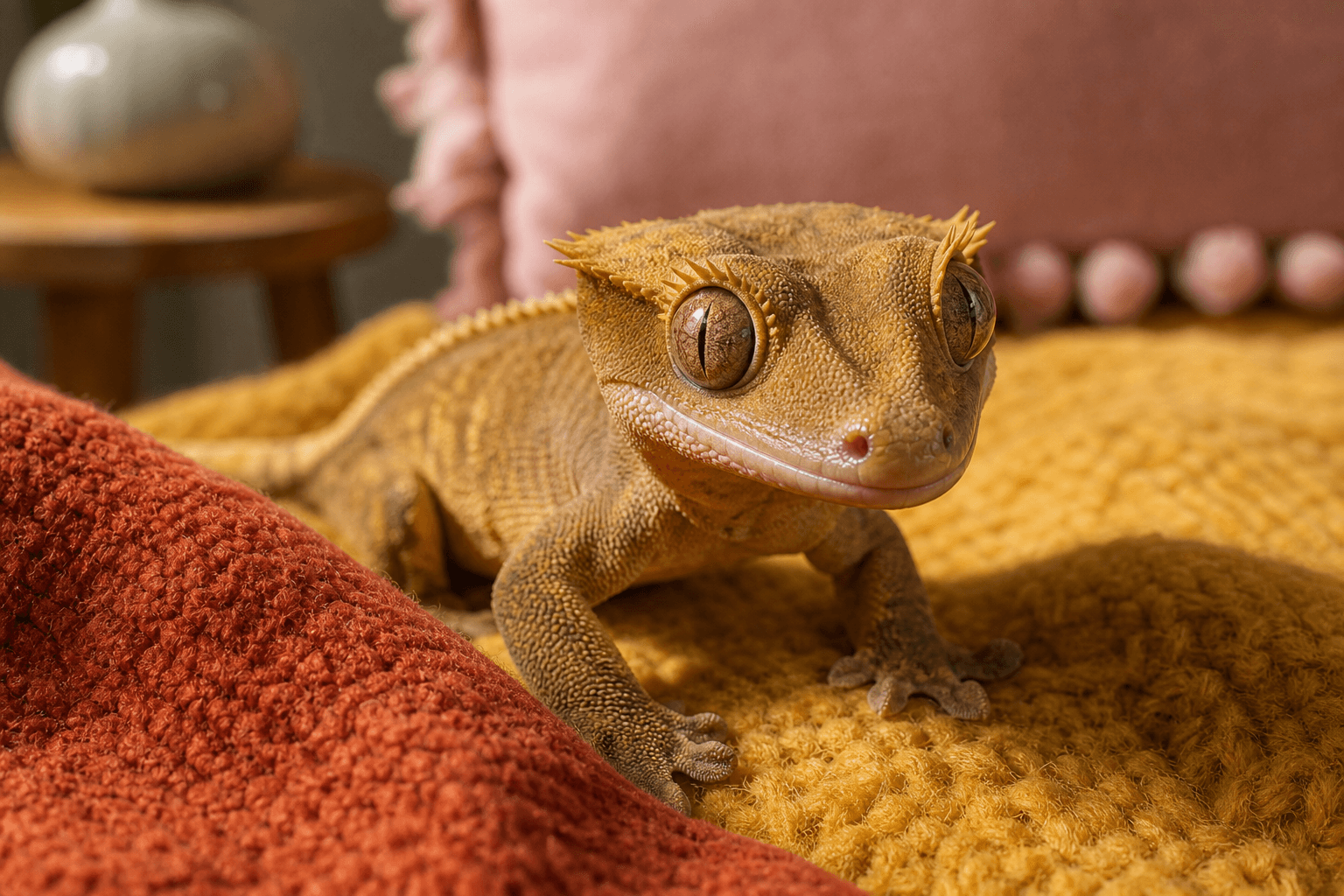
You fell for those big lashes and chill vibe. Same here.
Before you bring a crestie home, let's make sure the setup, care, and expectations are dialed in.
Here are the seven things we wish someone told us on day one—so you spend more time enjoying your gecko and less time troubleshooting.
1. The Enclosure Is Vertical, Not Horizontal
Crested geckos are arboreal. Think tall, not long.
A single adult thrives in a vertical 18x18x24 inch (or similar 45x45x60 cm) enclosure with lots of climbing options: cork rounds, sturdy branches, and dense fake or live plants.
Screen-front glass terrariums work well for ventilation; full-screen cages can dry out too fast unless your room is humid.
Get the climate right and half your work is done
2. Temperatures Are Mild—Don't Overheat
Cresties are comfortable at room temps. Daytime 72–78°F (22–25°C) with a small, gentle warm spot around 80–82°F (27–28°C) is plenty. Nights can safely drop to 65–70°F (18–21°C).
They overheat easier than they chill. Skip heat rocks and strong basking bulbs. If your home runs cool, use a low-watt heat source on a thermostat to create a mild gradient.
3. Humidity Swings Matter More Than a Single Number
Target a daily cycle: mist to reach 80–90% humidity in the evening, then let it dry back toward 50–60% by midday.
These swings mimic nature and help with shedding. Provide leaf cover so droplets linger for drinking, and ensure good airflow to prevent stagnant, constantly-wet conditions.
Mist Timing
Light morning mist, heavier evening mist when they wake.
Measure Right
Use a digital hygrometer placed mid-height, not on the floor.
Substrate
Moisture-holding mix (like coco fiber with leaf litter) stabilizes humidity.
Ventilation
Cross-vented enclosures prevent mold and respiratory issues.
4. Diet Is Easy—If You Do It Right
The backbone of a healthy crestie diet is a reputable commercial crested gecko meal replacement powder (MRP) mixed with water to smoothie consistency, offered 3–4 nights per week for adults and more frequently for juveniles.
Supplement with live insects (like crickets or dubia roaches) once or twice weekly. Always gut-load and dust lightly with calcium; if you provide UVB, use calcium without D3 most of the time.
Skip fruit purees and baby food—they skew nutrients and add sugar. Fresh water in a shallow dish plus droplets on leaves after misting cover hydration.
Balanced MRPs are formulated for their needs; fruit-only diets lead to deficiencies.
While many thrive on MRP alone, occasional appropriately-sized insects provide enrichment and protein variety.
5. Handling Is a Skill (and Tails Don't Grow Back)
Cresties can drop their tails when startled—and unlike some geckos, they won't regrow. Many adults are happily tailless, but prevention matters.
Handle over soft surfaces, use a gentle hand-over-hand "gecko treadmill," and limit sessions to a few minutes at first. Avoid grabbing from above or pinning.
- Let your gecko walk onto you rather than being picked up.
- Handle at night when they're naturally active.
- Avoid sudden movements and loud environments.
- Never restrain the tail or squeeze the body.
6. Lighting: Low-Light Doesn't Mean No UVB
Cresties are nocturnal-crepuscular, but low-level UVB (e.g., 2–5% in a shaded setup) supports calcium metabolism and overall well-being when provided correctly.
Mount UVB above a mesh top, create foliage-dense shade zones, and ensure the distance matches the bulb's output. Keep a normal day-night cycle with a modest daylight LED or natural room light.
Pros
Benefits of UVB
- Supports vitamin D3 synthesis and calcium use
- Encourages more natural activity patterns
- Can improve appetite and coloration
Cons
What to Watch
- Incorrect placement can cause overexposure
- Bulbs need regular replacement to maintain output
- Adds upfront cost and fixture complexity
7. Startup Costs Beat Monthly Costs
Initial setup is the big spend: enclosure, branches, plants, thermostat, UVB, hygrometer-thermometers, misting gear, and substrate.
Annual Cost Breakdown
| Expense | Annual Cost |
|---|---|
| Enclosure (18x18x24) & decor (one-time) | $180–$350 |
| Lighting/heat fixtures & thermostat (one-time) | $100–$200 |
| Gauges, misting bottle or system (one-time) | $20–$120 |
| Food (MRP) + insects (annual) | $120–$220 |
| Substrate & plant upkeep (annual) | $60–$120 |
| Vet fund (set aside) | $100–$200 |
| Est. Annual Total | $580–$1,210 first year (then ~$250–$500 annually) |
“Set up the habitat first. A dialed-in enclosure turns a nervous beginner into a confident keeper overnight.”
Juveniles do best in smaller, simple setups (like a 12x12x18) to find food easily, then upgrade to 18x18x24 as they grow.
Offer MRP every other night for adults (more for juveniles) and insects once or twice weekly. Remove uneaten food within 24–36 hours.
With spot-cleaning and ventilation, odor is minimal. Stagnant, constantly-wet enclosures are what smell—adjust airflow and cleaning.
House singly. Adult males fight, mixed pairs breed, and even females can stress each other. Cohab only with experience and space.